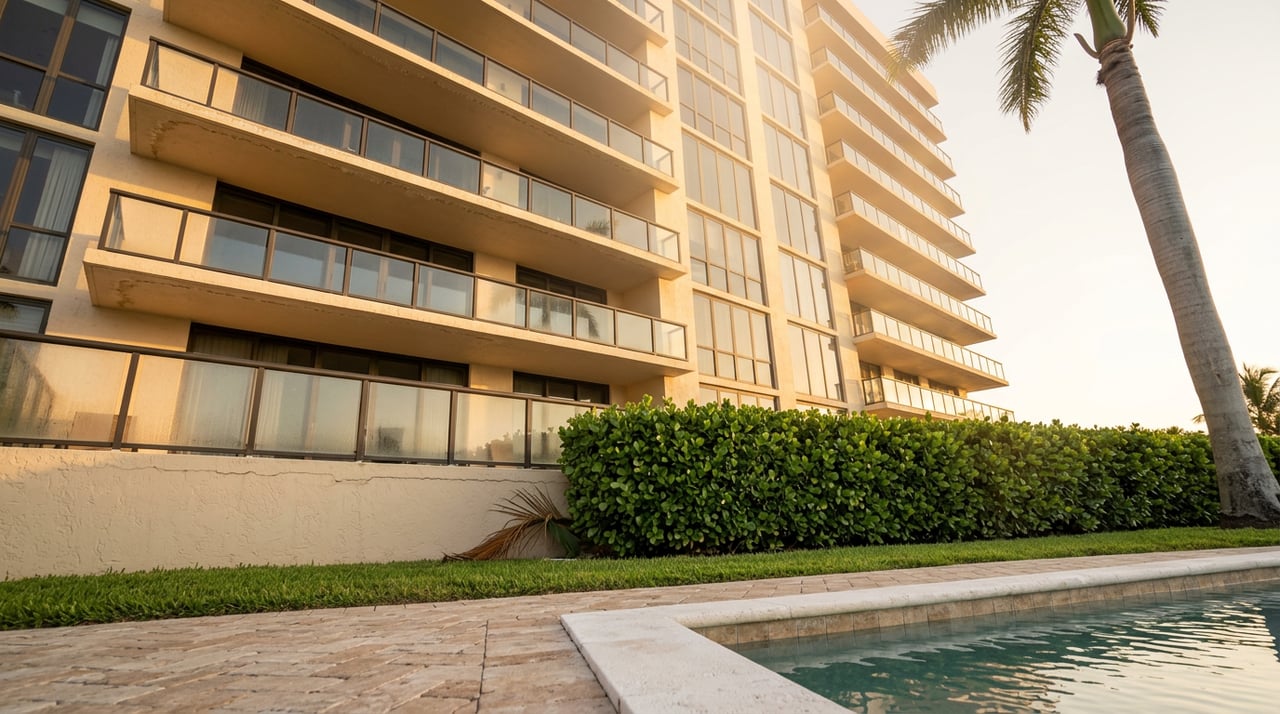
In Highland Beach, a Condo's Age Tells You Almost Nothing About Its Risk
September 17, 2026
September 17, 2026
Picture two oceanfront towers on South Ocean Boulevard, built within a year or two of each other, same eight or nine stories, same beach access, same monthly dues on paper. A buyer touring both this fall would reasonably assume they're looking at the same risk profile. They would be wrong, and the gap between them is exactly the thing most condo shopping guides skip past on the way to a generic warning about "older buildings."
Highland Beach's condo stock is concentrated almost entirely in the late 1970s through mid 1980s, the exact vintage now colliding with Florida's post-Surfside inspection and reserve laws. That collision means two buildings of identical age can be standing in completely different places financially, and the difference has almost nothing to do with how the lobby looks on a walkthrough.
Florida's Milestone Inspection program, created by Senate Bill 4-D in 2022 and refined by Senate Bill 154 the following year, requires condominium and cooperative buildings three or more habitable stories tall to undergo a structural inspection by a licensed engineer once the building reaches a set age. Inland buildings get 30 years. Coastal buildings within three miles of the shoreline, which describes essentially every condo in Highland Beach, can be required to inspect at 25 years if the local building official determines it's warranted.
Running alongside that is the Structural Integrity Reserve Study, or SIRS, which prices out the long-term funding needed for eight structural components: roof, load-bearing structure, fire protection, plumbing, electrical, waterproofing, windows and doors, and any other item over the annually adjusted cost threshold that affects those systems. Associations that existed before July 1, 2022 had to complete their first SIRS by December 31, 2025, with a narrow extension to December 31, 2026 available only if the milestone inspection is coordinated with it.
House Bill 913, effective in 2025, closed the loophole that let boards vote to waive or underfund those reserves. For budgets adopted on or after January 1, 2025, full funding is mandatory. There's no vote that gets a board out of it anymore. You can read the inspection and SIRS framework directly on the Florida Department of Business and Professional Regulation's condominium resources page, which lays out the age triggers and reporting requirements in plain statutory language.
That's the mechanism. Buildings that spent decades keeping dues low by underfunding reserves are now required to catch up all at once, and the bill lands as a special assessment. Reported cases elsewhere in South Florida have run from the low five figures to well over $100,000 per unit in the most severe situations, which gives a sense of how wide the range can swing depending on how deferred the maintenance was.
Here's what most buyers miss when they treat "1983" or "1985" as the risk indicator. A building's construction year sets the eligibility for milestone inspection and SIRS. It says nothing about where that building actually sits in the process today. Some associations moved early, funded properly, and finished their concrete restoration. Others are still waiting on a Phase 2 engineering report.
The clearest evidence of this split sits in Highland Beach's own listings right now. At least one oceanfront building on South Ocean Boulevard, formerly known as Ambassadors South and now marketed as 45 Ocean, is actively advertising to prospective buyers that its structural work and special assessments are already complete and paid in full, with concrete restoration finished. That's not a footnote. That's the building using its compliance as the selling point, because in this market it is one.
Compare that to a same-era building where the milestone inspection has been filed but the SIRS-driven funding plan hasn't been finalized, where board minutes reference an upcoming vote on financing options, or where the reserve balance sits well under what the study says is needed. Same decade of construction. Completely different exposure for whoever signs the closing documents next.
Parker Highland, an eight-story, 26-unit building on the sand built in 1981, and Coronado, the pair of 15-story towers built in 1983 and 1984 with 366 units combined, both sit squarely in the age band this law targets. Neither fact tells you anything about their current assessment status. That has to be pulled from the documents, not assumed from the year the certificate of occupancy was issued.
Before writing an offer on any Highland Beach condo built before the mid 1990s, there are four things worth requesting rather than assuming:
House Bill 1021, layered on top of the inspection and reserve laws in 2024, now requires associations with 25 or more units to post governing documents, budgets, and reserve studies through a website or app, and buyers have gained a real path to seeing this material before they're deep into a contract instead of discovering it at the estoppel stage.
State law sets the floor. Highland Beach's Building Department went further with its own Building Recertification Ordinance, most recently detailed in the town's updated Milestone Inspection Summary. The local program requires structural and electrical engineers who perform these inspections to register with the town, and it tightened reporting standards so that summaries include the building address, property control number, and the inspector's license number, with photographic documentation strongly encouraged rather than optional. You can read the town's own summary directly through Highland Beach's building department page.
That local layer matters for two reasons. It means Highland Beach inspection reports tend to be more thoroughly documented than the statutory minimum requires elsewhere in the state, which is useful when you're the one relying on the report to judge a building's condition. It also means the town has been paying close attention to this issue since before HB 913 forced the rest of the state to catch up, which is worth knowing if you're weighing Highland Beach against a comparable coastal town that hasn't layered on its own oversight.
The same logic runs in reverse for anyone holding a unit in an older Highland Beach building. A completed milestone inspection and a funded SIRS are no longer paperwork to file away. They're a marketing asset, the same way 45 Ocean is using its finished restoration work as a headline feature rather than a disclosure buried in the documents. Boards that got ahead of this timeline are handing their sellers a genuine edge over identical buildings still working through Phase 2 findings or an unresolved reserve gap.
Does a building with a completed assessment mean I'm paying a premium for that work? Not necessarily. The cost of the completed work is sunk into the building's history, not automatically priced into every unit's ask. What you're paying for is certainty, since the range of possible surprise costs is far narrower than in a building still working through its inspection cycle.
What happens if a special assessment passes while I'm under contract? The contract language controls this, and it typically turns on when the assessment was levied relative to the contract's effective date. This is exactly why requesting the estoppel certificate and recent board minutes before you're deep into a deal matters more than it used to.
Is a low HOA fee a good sign in an older Highland Beach building? On its own, no. A fee that looks low relative to comparable buildings can mean efficient management, or it can mean reserves were never adequately funded and the SIRS is about to force a correction. The only way to tell the difference is the reserve study itself.
Highland Beach's oceanfront inventory rewards buyers who ask the right question in the right order. Not "how old is this building," but "where does this specific building stand today." The JM Phillips Group works through exactly this kind of documentation before a client ever writes an offer, and if you're weighing a Highland Beach condo purchase or wondering what your current unit's compliance status means for its value, reach out and get your instant home valuation as a starting point for that conversation.
Stay up to date on the latest real estate trends.


Whether you're buying or selling, our expert team is here to guide you every step of the way.